New World Translation of the Holy Scriptures with References

Bible Abbreviation: NWTwR
ISBN: n/a
Publisher: Watchtower Bible and Tract Society of New York, Inc.
Publication Date: 1984
Pages: 1660+
Binding: hardback; dark maroon in color
Size: approx.7.25” x 9.25” x 1.75”

Features:
The NWTwR can only be characterized as a study Bible. It is a large, hardbound volume measuring approximately 7.25” x 9.25” x 1.75”. The colored endpaper maps are topographical and while attractive, are not as useful as one would initially expect. One cannot use them to identify rivers, nation borders or most other key features. The scriptures themselves are presented in two columns separated by a column of cross-references. In addition to the center cross-references, the volume is replete with footnotes that cover the gamut from Hebrew and Greek pronunciation guides and definitions, to ancient manuscript identifications and Dead Sea Scroll references, to transliterations and alternative translations, to geographical data and more. Following the Book of Revelation, is a section titled “Bible Words Indexed” which is a nicely abridged concordance. This is succeeded by an appendix with a dozen or more apologetic articles followed by a series of maps. These black and white maps compensate for the endpaper maps, as they are quite helpful. The final page is a list of addresses worldwide where one can write to request additional information.


Comments and Observations:
The NWTwR was groundbreaking when first published. It was the first to deliberately leave the path blazed by the Tyndale family of Bibles.1 The Greek basis was the Westcott and Hort and the Hebrew-Aramaic came from the Biblia Hebraica by Rudolf Kittel. In truth, the actual translation is somewhat hobbled by theological bias but no more so than the New American Bible or the New International Version. Just as the NAB definitely provides a Catholic outlook and the NIV offers an evangelical point of view, the NWTwR is a version that presents the Jehovah’s Witnesses’ perspective. That said, if a non-Jehovah’s Witness is going to use the NWTwR, they should be aware of the theology undergirding its distinctiveness. An example of the peculiarity of the Jehovah’s Witness theology can be found in the first two verses of Genesis.

“In [the] beginning God created the heavens and the earth. Now the earth proved to be formless and waste and there was darkness upon the surface of [the] watery deep; and God’s active force (וְרוּחַ אֱלֹהִים – Ruach Elohim – Spirit of God2) was moving to and fro over the surface of the waters.” (Gen 1:1-2 – NWTwR: comments in parenthesis added by author.)

The Witnesses believe that the Holy Ghost is God’s “active force”, not the living third member of the Godhead.3 Therefore, the NWTwR translates וְרוּחַ אֱלֹהִים (ruakh elohim) as “God’s active force” as opposed to the “Spirit of God” as most other versions do. The phrase “Spirit of God” is found in the NWTwR in only four places: Genesis 41:38, Exodus 31:3, Exodus 35:31 and Numbers 24:2. The terms Holy Spirit and Holy Ghost do not appear at all.

Other key terms also receive special handling. Depending on what or to whom it is applied, the New World Bible Translation Committee has translated the same Greek word, προσκυνέω (proskuneō), using two different English words. This is fine because all reliable lexicons list at least two meanings for προσκυνέω. What is interesting is how the New World Bible Translation Committee use the two definitions. When the NWTwR uses any form of προσκυνέω in a direct reference to the savior Jesus Christ, they translate it as “obeisance”. However almost invariably, when they translate προσκυνέω referencing anyone or anything other than Jesus, they use the term “worship.” This can be illustrated with John 9:38 and Hebrews 11:21, both of which use προσεκυνησεν (prosekunesen), a form of προσκυνέω.

“ο δε εφη πιστευω κυριε και προσεκυνησεν αυτω” (John 9:38)
“Then he said: “I do put faith [in him], Lord.” And he did obeisance to him.” (John 9:38)

“πιστει ιακωβ αποθνησκων εκαστον των υιων ιωσηφ ευλογησεν και προσεκυνησεν επι το ακρον της ραβδου αυτου” (Hebrews 11:21)
“By faith Jacob, when about to die, blessed each of the sons of Joseph and worshiped leaning upon the top of his staff.” (Hebrews 11:21)

The theological reason behind this interesting translation choice is that not only do the Jehovah’s Witnesses deny that the Holy Spirit as a member of the Godhead, but they also reject another member of the Godhead, Jesus, as being worthy of worship.

Probably the one NWTwR verse which promotes the most angst, rage and vitriol is found at John 1:1:

“In [the] beginning the Word was, and the Word was with God, and the Word was a god.” (John 1:1 – NWTwR)

Most versions do not have the indefinite article “a” before the final God and therefore they generally read “the Word was God” with God being capitalized. The NWTwR rendering thus becomes a direct challenge to the doctrine of the trinity. To be fair, it must be understood that the NWTwR is not the first version to contest the Trinity doctrine. That distinction may possibly be the 1865 edition of the Emphatic Diaglott by Benjamin Wilson.4

“In a beginning was the Word, and the Word was with the God, and a god was the Word.” (John 1:1 – Diaglott)

The next Bible to challenge the Trinity doctrine was the James Moffatt New Testament in 1913, followed ten years later by the Goodspeed New Testament in 1923.

“THE Logos existed in the very beginning, the Logos was with God, the Logos was divine”. (John 1:1 – JMNT)
“In the beginning the Word existed. The Word was with God, and the Word was divine.” (John 1:1 – GSNT)

Both of the translators of these versions were highly respected theologians and educators with impeccable qualifications and credentials. Their rendering of John 1:1 merely raised a few eyebrows and nothing more. While the NWTwR was not the first and is not the most recent version to take on the Trinity Doctrine, simply by its association with the Jehovah’s Witnesses, it is the most notorious.

Another attention-grabbing doctrine held by the Jehovah’s Witnesses is the belief that Jesus was executed on a crux simplex or an upright pole; 5 not a crux immissa or the familiar Christian cross. Because of this belief, instead of the word cross, the Greek σταυρός (stauros) is translated as torture stake.

“As we look intently at the Chief Agent and Perfecter of our faith, Jesus. For the joy that was set before him he endured a torture stake (σταυρον – stauron – cross), despising shame, and has sat down at the right hand of the throne of God.” (Hebrews 12:2 – NWTwR: comments in parenthesis added by author)

The reason this is a polarizing issue is that it strikes at the very heart of Christian symbology.

Speaking of symbology, Jehovah’s Witnesses do not salute flags, pledge allegiance to any person or nation nor do they serve in the military. This belief, too, is carried over to their translation.

“Then Jehovah said to Moses: “Make for yourself a fiery snake and place it upon a signal (נס – nace – flag) pole. And it must occur that when anyone has been bitten, he then has to look at it and so must keep alive.” (Numbers 21:8 – NWTwR: comments in parenthesis added by author.)

Where other versions translate the Hebrew נס (nês) as flag, ensign, standard, etc., the NWTwR uses the term signal.

An additional translation quirk is where most other translations use Lord to represent the unmentionable name of God, the NWTwR uses Jehovah. Jehovah is an invented word made by combining the transliteration (JHVH) of the tetragrammaton (יהוה) with the traditional vowel sounds of the Hebrew Adonai.6 It should be noted that the NWTwR is not the only translation to do so, nor was it the first. The Young's Literal Translation (1862), Darby Bible (1890) and the American Standard Version (1901), all rendered the Tetragrammaton as "Jehovah" in over 6,800 locations. Most others versions use “Jehovah” as well but to a much lesser extent.

However, Jehovah is not used in most translations of the New Testament at all. Conversely, in the New Testament of the NWTwR, the words Kurio (Lord) and Theo (God) and other closely related terms are often translated as Jehovah.

“But in reply he said: “It is written, ‘Man must live, not on bread alone, but on every utterance coming forth through Jehovah’s (θεοῦ – theou – God’s) mouth.’” (Matthew 4:4 – NWTwR: comments in parenthesis added by author)

“This, in fact, is the one spoken of through Isaiah the prophet in these words: “Listen! Someone is crying out in the wilderness, ‘Prepare the way of Jehovah, (κυριου – kuriou – the Lord) YOU people! Make his roads straight.’” (Matthew 3:3 – NWTwR: comments in parenthesis added by author.)

In fact, according to Aid to Bible Understanding,7 the Jehovah’s Witness’ Bible dictionary, there are 237 locations in NWTwR Greek Scriptures where the name Jehovah appears.


Old Testament Comparative Verse: Psalms 23:1-6 – NWTwR.

1 Jehovah is my Shepherd. I shall lack nothing.
2 In grassy pastures he makes me lie down; By well-watered resting-places he conducts me.
3 My soul he refreshes. He leads me in the tracks of righteousness for his name’s sake.
4 Even though I walk in the valley of deep shadow, I fear nothing bad, For you are with me; Your rod and your staff are the things that comfort me.
5 You arrange before me a table in front of those showing hostility to me. With oil you have greased my head; My cup is well filled.
6 Surely goodness and loving-kindness themselves will pursue me all the days of my life; And I will dwell in the house of Jehovah to the length of days.


New Testament Comparative Verse: Matthew 5:1-12 – NWTwR.

1 When he saw the crowds he went up into the mountain; and after he sat down his disciples came to him;
2 and he opened his mouth and began teaching them, saying:
3 “Happy are those conscious of their spiritual need, since the kingdom of the heavens belongs to them.
4 “Happy are those who mourn, since they will be comforted.
5 “Happy are the mild-tempered ones, since they will inherit the earth.
6 “Happy are those hungering and thirsting for righteousness, since they will be filled.
7 “Happy are the merciful, since they will be shown mercy.
8 “Happy are the pure in heart, since they will see God.
9 “Happy are the peaceable, since they will be called ‘sons of God.’
10 “Happy are those who have been persecuted for righteousness’ sake, since the kingdom of the heavens belongs to them.
11 “Happy are YOU when people reproach YOU and persecute YOU and lyingly say every sort of wicked thing against YOU for my sake. 12 Rejoice and leap for joy, since YOUR reward is great in the heavens; for in that way they persecuted the prophets prior to YOU.


Weaknesses:
The primary weakness of the NWTwR lies in the area of English grammar and word choice, which is sometimes poor. An example of inferior grammar can be found at Hebrews 1:8:

“But with reference to the Son: “God is your throne forever and ever, and [the] scepter of your kingdom is the scepter of uprightness.” (Hebrews 1:8 – NWTwR)

Every other translation I own translates it in a similar manner to how the New Revised Standard Version does.

“But of the Son he says, "Your throne, O God, is forever and ever, and the righteous scepter is the scepter of your kingdom.” (Hebrews 1:8 – NRSV)

I cannot think of one good theological reason for the Jehovah’s Witnesses to translate this verse in this manner. Nor did my research disclose a reason. Therefore, I think it is just what it is; an example of poor grammar.

For an illustration of a most unfortunate word choice, look at the final sentence in Acts 16:15.

“Now when she and her household got baptized, she said with entreaty: “If YOU men have judged me to be faithful to Jehovah, enter into my house and stay.” And she just made us come.” (Acts 16:15 – NWTwR)

That is sure to elicit snickers from the juvenile age group. A few years after the New World Translation was published, the Bible in Basic English translated the sentence in a similar manner.

The literalness of the NWTwR and its sometimes awkward word choice can get in the way of genuine understanding. A reader will have many an opportunity to ponder in bewilderment and ask themselves the question, “What does that even mean?” An example can usually be found on most any given page but 1 John 3:16 is produced below:

“Nevertheless, the reason why I was shown mercy was that by means of me as the foremost case Christ Jesus might demonstrate all his long-suffering for a sample of those who are going to rest their faith on him for everlasting life.” (1 Timothy 1:16 – NWTwR)

Fortunately, when such is the case, a parallel reading from another version will usually clear it up:

“But that is why God had mercy on me, so that Christ Jesus could use me as a prime example of his great patience with even the worst sinners. Then others will realize that they, too, can believe in him and receive eternal life.” (1 Timothy 1:16 – NLT)

In addition to such proclivities, the NWTwR is very difficult for sustained reading. It is so literal a translation that it is bereft of literary beauty and grace. It just does not flow well when it is read, especially when read out loud. It is not so much that it is a bad translation (and rest assured that it is not) as it is just that the translation was so badly executed. This translation is in desperate need of an English stylist and a good editor.


Strengths:
As mentioned, many of the nonconforming NWTwR passages can be directly traced to the theology and doctrine of the Jehovah’s Witnesses. However, in comparison to the volume as a whole, the verses affected by doctrinal bias are relatively few. Conversely, the literalness mentioned above as a weakness is also its strength. If anything, it is to be saluted for the consistency and literal word-for-word translation which produced a “most accurate”8 translation. It may make for tedious reading but the NWTwR is a pretty fair study Bible.


Summary:
There is no version, translation or edition of the Bible that is without error or blemish. Nor is there one without merit. For all its weaknesses and faults, the NWTwR is a remarkably good translation. Most of the complaints that people have with it is not with the translation itself but rather with the theology of the Jehovah’s Witnesses. The language of the NWTwR is relatively current and mostly without anachronisms or archaic terms. If you are alert to its theological bias without being frightened by it, and if you can put up with its wearisome readability, then the literalness, the extensive cross references and the educational footnotes makes for a worthy addition to your bookcase.

End Notes
1 “The NW’s text-base is the Westcott and Hort edition, which is the foundation of modern critical editions, and closely related to the more recent Nestle-Aland and UBS texts. It stays true to its text-base, and does not draw in readings from the inferior traditional text, as happens with the NASB, AB, and LB.” (Jason BeDuhn, “Truth in Translation”, Lanham MD: University Press of America, [2003], pg. 39)
2 All comments given in parenthesis within the body of the verse are in the following order: Original Greek or Hebrew – Transliteration – Common Translation.
3 “God’s Active Force; Holy Spirit. By far the majority of occurrences of Ruach and pneuma relate to God’s spirit, his active force, his holy spirit. … The Scriptures themselves unite to show that God’s holy spirit is not a person but is God’s active force by which he accomplishes his purpose and executes his will.” (“Insight on the Scriptures”, Brooklyn, NY: Watch Tower Bible and Tract Society of New York, [1988], vol. 2 of 3, pg 1019)
4 Interestingly enough, the Diaglott ended up with the Jehovah’s Witnesses even though Wilson was the founder of the denomination called the Church of God General Conference from which came the well respected Atlanta Bible College.
5 “The inspired writers of the Christian Greek Scriptures wrote in the common (koi∙ne’) Greek and used the word stau∙ros’ to mean the same thing as in the classical Greek, namely, a simple stake, or pale, without a crossbeam of any kind at any angle. There is no proof to the contrary.” (“New World Translation of the Holy Scriptures with References”, Brooklyn, NY: Watch Tower Bible and Tract Society of New York, [1984], pg. 1577)
6 “When the vowel points were added to the Heb, text the rule, in the case of words written but not read, was to attach to these words the vowels belonging to the words read in place of them. Thus they attached to YHWH the points of ’ădônāy; hence the form Yehôwāh and the name Yeh’v’h.” (Merrill F. Unger, R.K. Harrison, ed., “The New Unger’s Bible Dictionary”, Chicago: Moody Press, [1985], pg. 781)
7 “Outstanding, however, in this regard is the New World Translation, used throughout this work, in which the divine name in the form “Jehovah” appears 237 times in the Christian Greek Scriptures.” (“Aid to Bible Understanding”, Brooklyn, NY: Watch Tower Bible and Tract Society of New York, [1971], pg. pg 888)
8 In 2003, Professor Jason D. BeDuhn, of Northern Arizona University, compared the King James Version, the New Revised Standard Version, the New International Version, the New American Bible, the New American Standard Bible, the Amplified Bible, the Living Bible, Today's English Version and the New World Translation. He concluded that: “While it is difficult to quantify this sort of analysis, it can be said that the NWT emerges as the most accurate of the translations compared. Holding a close second to the NWT in its accuracy, judging by the passages we have looked at, is the NAB.” (Jason BeDuhn, “Truth in Translation”, Lanham, MD: University Press of America, [2003], pg. 163)
 

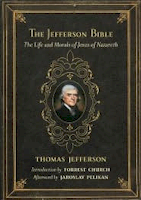
Jefferson Bible – The Life and Morals of Jesus of Nazareth

Bible Abbreviation: JB
ISBN: 798-0-8070-7714-6
Publisher: Boston: Beacon Press
Publication Date: 1989
Pages: 171
Binding: Hardcover
Size: 7.25 x 5.25 x .75

Features:
This small volume consists of a short preface, an introduction (both by Forrest Church) and a few photographic reproductions of Jefferson’s original manuscript.  This is followed by the text which in this volume contains only the English. It is presented in a two columns with one column showing the source of the verses.  Following the text is a commentary by Jaroslav Pelikan.  This, in turn, is followed by an index of verses sorted by the gospel from which they were drawn.
 
Comments and Observations:
In 1804, three years into his Presidency of the United State of America, Jefferson began a project he titled The Philosophy of Jesus of Nazareth.  Some years later, on 9 January 1816, Thomas Jefferson wrote to his long time friend, Charles Thomson, about this book he had composed from the four gospels of the New Testament.

“I, too, have made a wee-little book from the same materials, which I call the Philosophy of Jesus; it is a paradigma of his doctrines, made by cutting the texts out of the book, and arranging them on the pages of a blank book, in a certain order of time or subject. A more beautiful or precious morsel of ethics I have never seen; it is a document in proof that I am a real Christian, that is to say, a disciple of the doctrines of Jesus.”1

In 1819 he began anew and it is this second work which the world knows as the Jefferson Bible but which Jefferson called “The Life and Morals of Jesus of Nazareth”. In spite of its nickname, the Jefferson Bible is not actually a Bible or even a New Testament.  Rather, it is a much abbreviated harmony or redaction of the four gospels.  In its original format, it was arranged in four columns with each column being in either Greek, Latin, French or English.  Jefferson purchased three sets of two identical Bibles. The Greek and Latin text was a parallel edition comprising the Leusden’s Greek Testament paired with the Montanus’ Latin.  The French edition was identical to the Paris Ostervald “le Nouveau Testament corrige sur le Grec.”  The English edition was the King James Version.  One could therefore compare the Jefferson Bible to Tatian’s Diatessaron crossed with Ximenes’ Complutensian Polygot. 

With a razor in hand Jefferson detached the words of Jesus along with a minimal amount of history. These snippets he pasted into a chronological/topical order comingling verses from each of the gospels and disregarding any historical order other than his own.  He then pasted them into a book of blank pages. (Note: The volume under review is lacking the Greek, Latin and French versions.) A page from the Jefferson Bible follows:

L. 3/1 
Now in the fifteenth year of the reign of Tiberius Caesar, Pontius Pilate being governor of Judaea, and Herod being tetrarch of Galilee, and his brother Philip tetrarch of Ituraea and of the region of Trachonitis, and Lysanias the tetrarch of Abilene,
2
Annas and Caiaphas being the high priests,
Mk. 1/4
John did baptize in the wilderness,
Mt. 3/4 
And the same John had his raiment of camel's hair, and a leathern girdle about his loins; and his meat was locusts and wild honey.
5
Then went out to him Jerusalem, and all Judaea, and all the region round about Jordan,
6
And were baptized of him in Jordan,
Mt. 3/13 
Then cometh Jesus from Galilee to Jordan unto John, to be baptized of him.
L. 3/23
And Jesus himself began to be about thirty years of age,
J. 2/12
After this he went down to Capernaum, he, and his mother, and his brethren, and his disciples: and they continued there not many days.
13
And the Jews' passover was at hand, and Jesus went up to Jerusalem,
14
And found in the temple those that sold oxen and sheep and doves, and the changers of money sitting:
15
And when he had made a scourge of small cords, he drove them all out of the temple, and the sheep, and the oxen; and poured out
Jefferson recorded the order of the verses he used in a “Table of the Texts from the Evangelists employed in this Narrative and of the order of their arrangement.”  From this table it is relatively easy to see what Jefferson removed and what he retained.

Old Testament Comparative Verse: Psalms 23:1-6 – N/A

New Testament Comparative Verse: Matthew 5:1-12 (Note: this is identical to the King James Version from which it was taken.)
Mt. 5/1
And seeing the multitudes, he went up into a mountain: and when he was set, his disciples came unto him:
2
And he opened his mouth, and taught them, saying,
3
Blessed are the poor in spirit: for theirs is the kingdom of heaven.
4
Blessed are they that mourn: for they shall be comforted.
5
Blessed are the meek: for they shall inherit the earth.
6
Blessed are they which do hunger and thirst after righteousness: for they shall be filled.
7
Blessed are the merciful: for they shall obtain mercy.
8
Blessed are the pure in heart: for they shall see God.
9
Blessed are the peacemakers: for they shall be called the children of God.
10
Blessed are they which are persecuted for righteousness’ sake: for theirs is the kingdom of heaven.
11
Blessed are ye, when men shall revile you, and persecute you, and shall say all manner of evil against you falsely, for my sake.
12
Rejoice, and be exceeding glad: for great is your reward in heaven: for so persecuted they the prophets which were before you.
Strengths & Weaknesses:
Thomas Jefferson wished his book to represent the unobscured morals and philosophy of Jesus held together within a framework consisting of the barest essentials from the events from Christ's life.  To that end he succeeded admirably.  However, on the cutting room floor, Jefferson left the virgin birth, the miracles, the resurrection, and the lives and teachings of his apostles.  In short, in paring all but the morals and philosophy of Jesus from the Bible, Jefferson also cut out the heart of Christianity.

1 Excerpts from the "Correspondence of Thomas Jefferson"
(http://www.cooperativeindividualism.org/jefferson_m_03.html) Retrieved on 21 July 2011

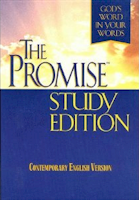
Contemporary English Version - The Promise Study Edition

Bible Abbreviation:  CEV
ISBN:  0-8407-0905-6
Publisher:  Thomas Nelson, Inc.
Publication Date: 1996
Pages: 1507
Binding:  Hard bound
Size: 6.75” x 9.5” x 1.5”


Features: At the back of the volume, it has maps, a Bible Chronology and what it calls a mini-dictionary.  The mini dictionary is divided up into twenty-one sections, each with specialized information such as People, Prophets, Languages, Festivities and Holy Days, etc.  It is lacking a concordance.  Each book is launched with a small amount of introductory information specific to it.  The Bible text is presented in a single column per page.  Small blurbs of commentary – titled Promise For  and For My Life – is presented in separate boxed off areas.  In addition key scriptures called Promise Quotes are hi-lited in an enlarged font.  I know this sounds busy but it is not.  It is very tastefully done and looks quite pleasing.  At the back of each book is a list of end notes which provide explanation concerning the Biblical languages, alternate translations, contextual clues, etc.  However, these are keyed within the verses of the Bible text with an alpha character in such a small font that it defies notice. 

Comments and Observations: The CEV is a thought-for-thought or functional equivalent translation.  It was first published in 1995 and the copyright holder is the American Bible Society.  The Promise Study Edition was printed by Thomas-Nelson Publishers.  The CEV’s text is in contemporary American idiom making it very easy for the average person to read and understand. 


Old Testament Comparative Verse: Psalms 23:1-6.
1  You, Lord, are my shepherd. I will never be in need.
2  You let me rest in fields of green grass.
You lead me to streams of peaceful water,
3  and you refresh my life.
You are true to your name,
and you lead me along the right paths.
4  I may walk through valleys as dark as death,
but I won't be afraid.
You are with me,
and your shepherd's rod makes me feel safe.
5  You treat me to a feast, while my enemies watch.
You honor me as your guest,
and you fill my cup until it overflows.
6  Your kindness and love will always be with me each day of my life,
and I will live forever in your house, Lord.


New Testament Comparative Verse: Matthew 5:1-12
1  When Jesus saw the crowds, he went up on the side of a mountain and sat down. Jesus' disciples gathered around him, 2  and he taught them:
3  God blesses those people who depend only on him.
They belong to the kingdom of heaven!
4  God blesses those people who grieve.
They will find comfort!
5  God blesses those people who are humble.
The earth will belong to them!
6  God blesses those people who want to obey him more than to eat or drink.
They will be given what they want!
7  God blesses those people who are merciful.
They will be treated with mercy!
8  God blesses those people whose hearts are pure.
They will see him!
9  God blesses those people who make peace.
They will be called his children!
10  God blesses those people who are treated badly for doing right.
They belong to the kingdom of heaven.
11  God will bless you when people insult you, mistreat you, and tell all kinds of evil lies about you because of me. 12  Be happy and excited! You will have a great reward in heaven. People did these same things to the prophets who lived long ago.


Weaknesses:  The paper on which this version is printed does not seem as strong or as substantial as a study Bible should be.  That is a bit nit-picky so I’ll move on.  The editors called this volume a Study Bible yet it is lacking information that is key to the study of the scriptures.  For example, the introductory information at the beginning of each book does not provide an approximate date the book was written.  What information is provided following the various books is referenced in such a manner as to be ignored by most readers.  If you are looking for an in-depth study Bible, with information that will immerse you in the technical details of the Bible, this is not it.


Strengths:
There are Bibles that are more rigorously accurate in translation (the King James Version or the New American Standard Bible most readily come to mind) but this version makes the Bible truly understandable for the common person.  What it lacks in word-for-word accuracy, it counterbalances with pure reading enjoyment.  If you want to read the Bible from cover-to-cover, this is the Bible with which to do it.  It is an easy read, with just enough added information so that you can keep focused on reading and not go off on in-depth study tangents.


Summary:
I love the American Bible Society’s CEV. I am not enthralled with study materials that Thomas-Nelson packaged with it.  The best I can say for the so called study materials is that they do not get in the way of the enjoyment of reading the CEV.

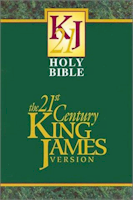
21st Century King James Version

Bible Abbreviation:  KJ21
ISBN:  0-9630512-3-7
Publisher:  Deuel Enterprises, Inc.
Publication Date: 1994
Pages: 1880
Binding:  Hard
Size: 6" x 8.75" x 2.75"


Features:
The text is presented in a single column with footnotes.  It is lacking maps, concordance and dictionary. 

Some passages have two diamonds (♦♦) placed at the beginning and a single diamond (♦) at the end.  These indicate Biblical verses that are included in the Three Year Common Lectionary. The lectionary is utilized by many mainline denominations for use in sermons, scriptural readings, church bulletins, etc.  To show what this looks like, I’ve copied the last two verses from the New Testament, Revelation 22:20-21: 

 
♦♦ 20 He that testifieth these things saith,
 “Surely I come quickly.”
Amen. Even so, come, Lord Jesus.
21 The grace of our Lord Jesus Christ be with you all.
Amen. ♦ 

 
An appendix contains the preface to the original King James Version of 1611(KJV).   Like the text of the Bible, the preface has been updated but unlike the Bible text, which is complete and not missing anything, the preface has been abridged.  It is worth the read. 

Comments and Observations:
Issued midway through the final decade of the 20th century, the 21st Century King James Version (KJ21) is not a new translation or a revision, but rather a minimalist update of the King James Version.   Obsolete and/or archaic words, for the most part, have been replaced by with current equivalents.  For example, when you read Isaiah 3:18 you may wonder what the word caul means. 

KJV In that day the Lord will take away the bravery of their tinkling ornaments about their feet, and their cauls, and their round tires like the moon, 

So you drag out your Random House Webster’s Dictionary published back in 1996 and you read: 

 
caul (kôl), n. 1. a part of the amnion sometimes covering the head of a child at birth. 2. greater omentum. [1300–50; Middle English calle < Middle French cale, probably back formation from calotte kind of cap; see calotte] 

 
You might still be puzzled.  However, if you read the same verse from the 21KJ, your puzzlement should disappear: 

 
21KJ In that day the Lord will take away the bravery of their tinkling ornaments about their feet, and their hair nets and their round ornaments like the moon, 

 
With that said, there are some passages which could have been updated and were not.  For example, compare Mark 1:34 in both the KJV and the KJ21: 

KJV “And he healed many that were sick of divers diseases, and cast out many devils; and suffered not the devils to speak, because they knew him.” 

 
KJ21 “And He healed many who were sick with divers diseases, and cast out many devils; and He suffered not the devils to speak, because they knew Him.”  

 
With only minor changes in capitalization and word choice, the two are essentially the same.  In my opinion, divers should have been changed to something like various, different or a variety of, with the former being the preferred. 

 
Just as the wording has been updated, the spelling, punctuation, capitalization, and paragraphing have also been modernized.  The poetic verses have been formatted for ease of reading.  However, the time-honored Biblical language of its historic ancestor, the King James Version of 1611, has been retained, as the comparative verses below illustrate.

The application of font options is dreadful.  Some passages which were deemed by the publisher to be “more familiar” are given in bolded Roman font, while those  “less familiar” are placed in normal Roman font. The chapter headings are in a small sans-serif font.  The publishers used italics to designate the words of Christ.  That may explain why the KJ21 did not retain was the KJV practice of italicizing the words which are not in Greek/Hebrew but which are needed to make sense in English.  I have difficulty with any Bible which fails to indicate the words that are in the text but do not exist in the Greek or Hebrew. The KJ21 fails in this aspect. 

Unlike other modern versions, whole and partial passages have not been omitted.  Even the original KJV chapter summaries were retained. 

 
Old Testament Comparative Verse: Psalms 23:1-6.
1   The LORD is my shepherd;
I shall not want.

2   He maketh me to lie down in green pastures;
He leadeth me beside the still waters.
3   He restoreth my soul;
He leadeth me in the paths of righteousness
for His name's sake.

4   Yea, though I walk through the valley of the shadow of death, I will fear no evil;
for Thou art with me;
Thy rod and Thy staff, they comfort me.
5   Thou preparest a table before me in the presence of mine enemies;
Thou anointest my head with oil;
my cup runneth over.
6   Surely goodness and mercy shall follow me all the days of my life;
and I will dwell in the house of the LORD for ever. 

 
New Testament Comparative Verse: Matthew 5:1-12.
1   And seeing the multitudes, He went up onto a mountain; and when He was set, His disciples came unto Him. 2   And He opened His mouth and taught them, saying,
3    “Blessed are the poor in spirit,
for theirs is the Kingdom of Heaven.
4   Blessed are they that mourn,
for they shall be comforted.
5   Blessed are the meek,
for they shall inherit the earth.
6   Blessed are they that hunger and thirst after righteousness,
for they shall be filled.
7   Blessed are the merciful,
for they shall obtain mercy.
8   Blessed are the pure in heart,
for they shall see God.
9   Blessed are the peacemakers,
for they shall be called the children of God.
10   Blessed are they that are persecuted for righteousness' sake,
 for theirs is the Kingdom of Heaven.
11   Blessed are ye when men shall revile you and persecute you,
and shall say all manner of evil against you falsely for My sake.
12   Rejoice and be exceeding glad, for great is your reward in Heaven;
for so persecuted they the prophets who were before you.  

 
Strengths:
Everything I have read and compared it with seems to closely follow the KJV and the Greek of the Textus Receptus.  While I would argue with a few choices, for the most part, the words which they used to replace the KJV archaic words are well chosen.  I know that some will have problems with the fact that the publishers kept the thee, thy, and thine type pronouns.  I do not.  In the KJV, the thee, thy, and thine are singular pronouns and you and your are plural. Greek and Hebrew also uses different pronouns to distinguish between singular and plural.  Therefore it makes perfect sense to retain them if for no other reason than for understandability.  It beats the bejeebies out of using the Southern expression, y’all.

Weaknesses:
Typographically, this version is a mess.  The use of the various fonts styles are jarring. Furthermore, I personally do not need an editor to tell me which passages are  “more familiar “ and which are not.  I suspect that the KJ21 is not a serious contender as a KJV replacement, simply because of the aesthetics.  This is sad because aside from the choices made in the fonts, this is mostly how an updated King James Version should be presented.   It is much more readable and understandable than most other modern versions claiming KJV lineage.